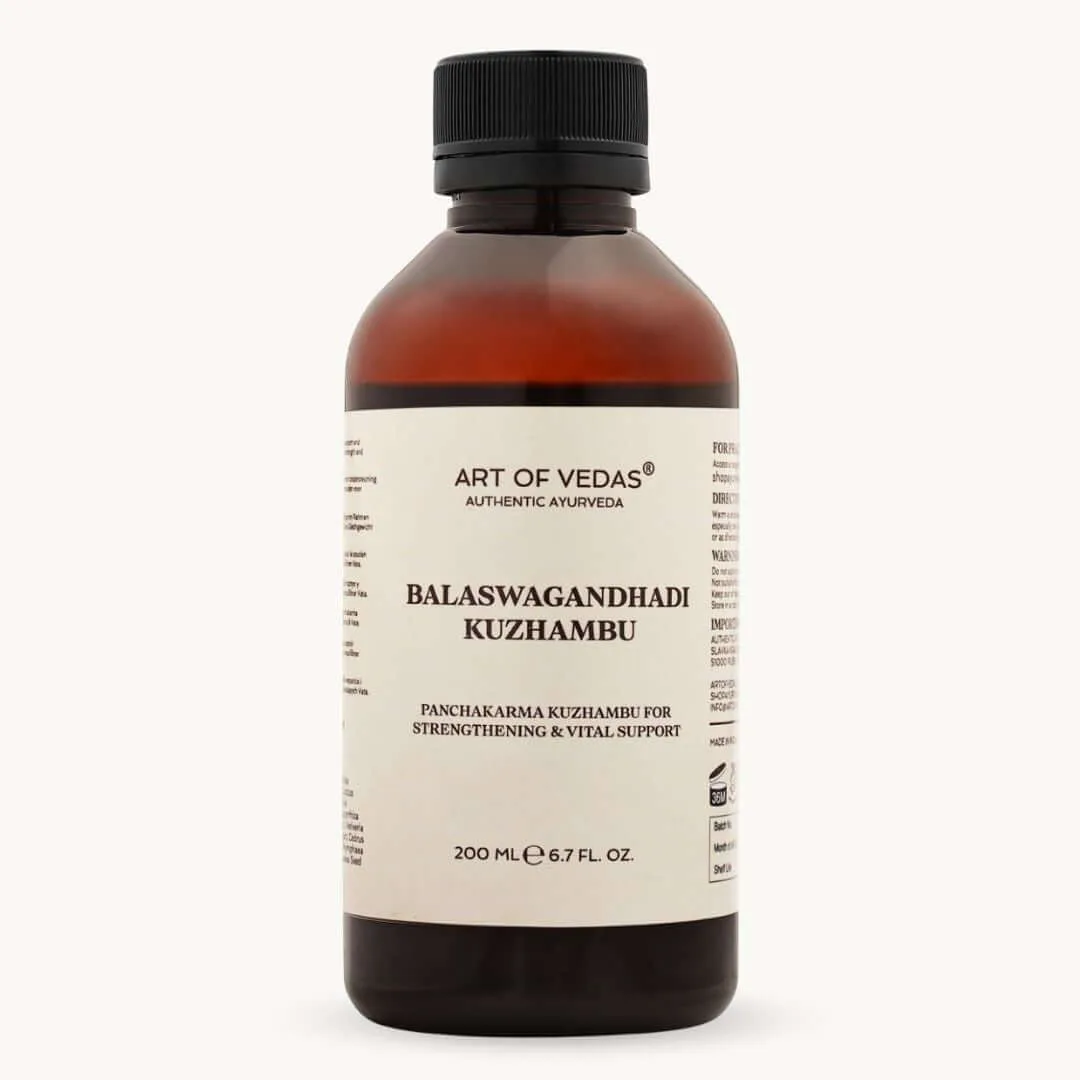
Balaaswagandhadi Kuzhambu is the semi-solid form of one of classical's best known strengthening formulas, built around Bala and Ashwagandha. Where a classical Thailam flows and spreads, a Kuzhambu holds its shape, stays on the applied area and releases its botanicals slowly. That behaviour makes it the format classical households traditionally reserve for focused, local work on shoulders, thighs and calves at the end of a demanding day. This guide explains how to warm the preparation, how much to use and how to apply it properly, whether you train regularly or simply carry the day in your muscles.
A semi-solid preparation, not an oil
The first point to understand is that a Kuzhambu is not an oil and should not be handled like one. It is prepared on a base of three fats, traditionally sesame, coconut and castor, cooked slowly with herbal decoctions and fresh plant pastes until the finished preparation sets to a soft, dense consistency. At room temperature it holds together in the jar. On warm skin it softens, spreads under the hands and then remains where you have placed it instead of running off. Absorption is gradual, which is exactly why the tradition favours this format for targeted local application rather than fast full-body massage. If the format is new to you, our guide on how to warm and apply a Kuzhambu covers the general method in detail.
When tradition reaches for Balaaswagandhadi Kuzhambu
Balaaswagandhadi takes its name from Bala, the botanical Sida cordifolia, and Ashwagandha, Withania somnifera, two plants with a long standing in the Ayurvedic strength tradition. In classical practice the Kuzhambu format of this formula is traditionally associated with:
- Focused massage of the shoulders, upper arms, thighs and calves after training or physical work
- Evening routines for people whose muscles feel thoroughly used at the end of the day
- Post-exertion recovery rituals in the classical sense of warmth, rest and unhurried touch
- Seasonal Vata care in the colder months, when richer and slower textures are preferred
- Sessions where the preparation should stay in place for twenty minutes or more
None of this makes it a performance product in the modern sense. It is a traditional preparation that belongs inside a routine of rest, and it rewards patience rather than haste.
How to warm and apply it, step by step
Begin with warmth. Take a warm shower or spend a few minutes moving gently so the skin is receptive, then place the closed jar of Balaaswagandhadi Kuzhambu in a bowl of hot water for five to ten minutes. The preparation should soften noticeably, but it does not need to become liquid. Never warm it over direct heat.
Scoop out roughly a teaspoon for each area you intend to work on. Soften it briefly between your palms, then apply it to one region at a time with slow, firm strokes: long movements along the muscles of the arms and legs, broad circles over the shoulders. Because a Kuzhambu absorbs slowly, resist the urge to keep adding more. A thin, even layer that the skin can gradually take up is the traditional measure.
Leave the preparation on the skin for twenty to thirty minutes. Keep the body warm during this time and avoid draughts. Afterwards, wipe away any residue with a warm, damp towel and rinse under a warm shower with a mild cleanser. Use towels you reserve for massage, as the rich base can mark fine fabrics.
What is in the jar
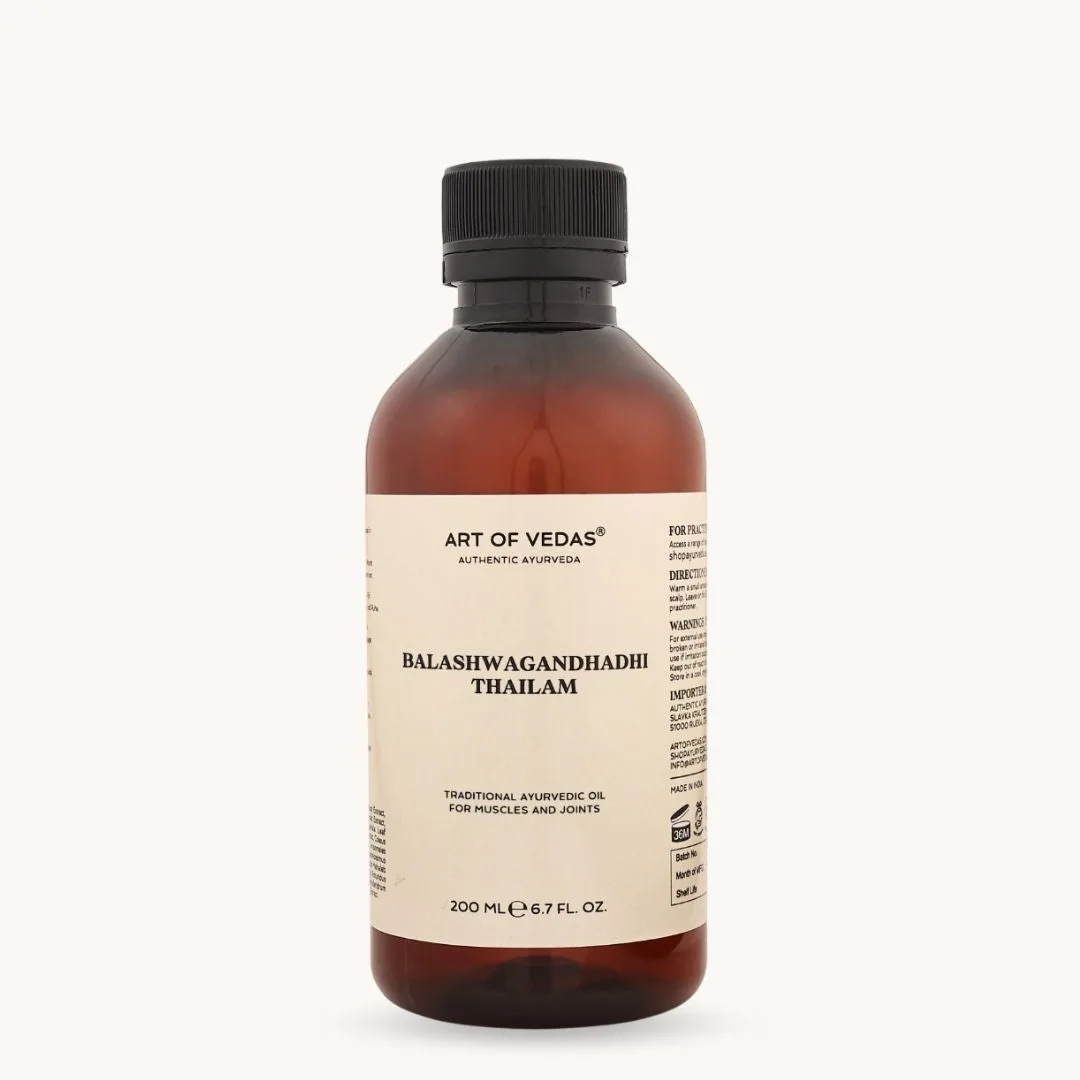
The formula is anchored by Bala and Ashwagandha, supported by a group of classical botanicals that are first prepared as a decoction and a fresh paste, then cooked into the three-fat base over a low fire until the water content has evaporated and the preparation reaches its characteristic soft set. You can read about the formula and its traditional context in our complete guide to Balaaswagandhadi Kuzhambu, and about its flowing counterpart in our guide to Balaswagandhadi Thailam. The Balaswagandhadi Thailam itself is the natural companion when you want the same formula in a texture suited to full-body Abhyanga.
Frequently Asked Questions
How often can I use Balaaswagandhadi Kuzhambu?
In the tradition it is used as often as the routine calls for it, from daily evening application on hard-working legs to a few sessions a week after training. Let comfort and available time set the rhythm.
Should I choose the Kuzhambu or the Thailam?
Choose the Kuzhambu for slow, targeted work on specific muscle groups and the Thailam for flowing full-body Abhyanga. Many households keep both and let the day decide.
Do I need to wash it off?
Yes. After twenty to thirty minutes, wipe off the residue and rinse with warm water. The skin has taken up what it needs within that window.
Can I apply it before sleep?
An evening application suits the formula well, provided you allow time to wipe and rinse before bed so the bedding stays clean. Warm calves and shoulders respond particularly well at that hour.
How much should I use in one session?
A teaspoon per body region is a sensible starting measure. A thin, even layer worked in slowly serves the purpose better than a thick coating.
This article describes traditional Ayurvedic practice for general information and personal care. It is not medical advice. If you are pregnant, have a health concern or know your skin reacts easily, please speak with a qualified professional before beginning a new routine.